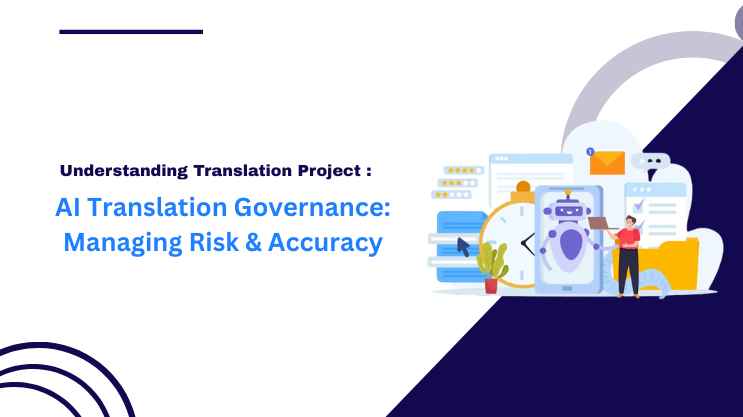
AI-powered translation is transforming how organizations scale multilingual content. While it delivers speed and cost efficiency, unmanaged AI translation can introduce serious risks-ranging from mistranslations to compliance failures. AI translation governance provides the framework needed to balance automation with accuracy, accountability, and trust.
What Is AI Translation Governance?
AI translation governance refers to the policies, processes, and controls used to manage how AI translation tools are selected, deployed, monitored, and improved. It ensures that AI-generated translations meet quality, security, and compliance standards while aligning with business goals and brand values.
Why AI Translation Governance Matters
- Risk Reduction: Prevents legal, financial, and reputational risks caused by inaccurate translations.
- Quality Assurance: Maintains linguistic accuracy, tone, and contextual integrity.
- Regulatory Compliance: Supports adherence to data protection and industry regulations.
- Brand Consistency: Ensures AI outputs align with approved terminology and messaging.
- Scalable Growth: Enables safe expansion of multilingual content across markets.
Key Risks of Ungoverned AI Translation
- Contextual Errors: AI may misinterpret intent, tone, or industry-specific language.
- Data Security Concerns: Sensitive information may be exposed without proper controls.
- Inconsistent Terminology: Lack of glossaries can lead to fragmented messaging.
- Cultural Insensitivity: Literal translations may overlook cultural nuances.
Best Practices for Managing AI Translation Risk
- Define Clear Governance Policies: Establish when AI can be used independently and when human review is required.
- Use Human-in-the-Loop Models: Combine AI efficiency with expert human oversight for accuracy.
- Implement Terminology Management: Use glossaries and style guides to guide AI outputs.
- Monitor Quality Continuously: Regularly review AI translations using quality metrics and audits.
- Secure Data Handling: Ensure translation platforms comply with data privacy and security standards.
Tools Supporting AI Translation Governance
- Translation Management Systems (TMS): Centralize workflows and enforce governance rules.
- AI Quality Evaluation Tools: Measure accuracy, fluency, and consistency.
- Glossaries & Style Guides: Standardize terminology across AI and human translations.
- Access Controls & Audit Logs: Track usage and maintain accountability.
The Future of AI Translation Governance
As AI translation continues to evolve, governance will become a strategic necessity-not a technical afterthought. Organizations that invest in strong governance frameworks will gain the benefits of AI while minimizing risks. The future lies in collaborative ecosystems where AI accelerates workflows and human expertise ensures accuracy, ethics, and cultural intelligence.
Conclusion
AI translation governance is essential for organizations operating in multilingual environments. By managing risk, ensuring accuracy, and maintaining oversight, businesses can confidently leverage AI translation at scale. A well-governed AI translation strategy transforms automation into a trusted asset rather than a liability.
AI translation governance, AI translation risk management, machine translation accuracy, human-in-the-loop translation, multilingual AI, translation compliance, Honey Translation Services.