
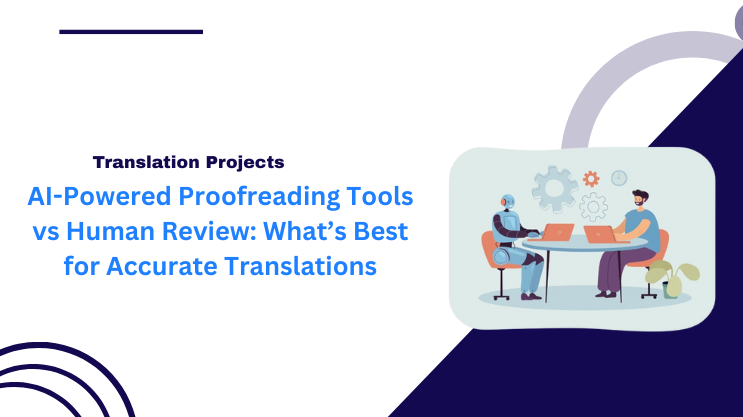
In today’s fast-paced digital world, speed and accuracy are critical for global communication. As businesses expand into multilingual markets, proofreading translated content has become just as important as the translation itself. With the rise of AI-powered proofreading tools, many companies now ask an important question: Should they rely on AI tools or human reviewers for quality assurance?
At Honey Translation Services, we believe the answer lies in understanding the strengths and limitations of both approaches – and how to use them strategically for the best results.
The Growing Role of Proofreading in Translation
Proofreading ensures that translated content is not only grammatically correct but also culturally appropriate, consistent, and aligned with brand voice. Errors in translated materials can damage credibility, confuse customers, and even lead to legal or compliance issues.
As technology evolves, AI proofreading tools promise faster turnaround times and lower costs. But can they truly replace human expertise?
What Are AI-Powered Proofreading Tools?
AI proofreading tools use machine learning, natural language processing (NLP), and language models to detect errors in spelling, grammar, punctuation, and sentence structure. Some advanced tools also analyze tone, readability, and terminology consistency.
These tools are commonly used to quickly scan large volumes of content and flag potential issues. For businesses handling high-volume multilingual content, AI proofreading can be an efficient first layer of quality control.
Advantages of AI Proofreading Tools
AI-powered tools offer several benefits, especially in speed and scalability.
They can process large files within seconds, making them ideal for tight deadlines. AI tools also ensure consistency across documents by checking repeated terms, formatting, and basic linguistic rules. From a cost perspective, they are often more affordable than full human review for preliminary checks.
At Honey Translation Services, AI tools help streamline workflows by catching obvious errors early in the process.
Limitations of AI Proofreading in Translation
Despite their efficiency, AI tools have clear limitations when it comes to professional translation quality.
AI struggles with context, cultural nuances, idiomatic expressions, and industry-specific language. It may miss subtle meaning shifts, awkward phrasing, or mistranslations that technically follow grammar rules but sound unnatural to native speakers.
AI tools also cannot evaluate whether content aligns with brand tone, marketing intent, or local audience expectations – critical elements for global communication.
Why Human Review Still Matters
Human reviewers bring linguistic intelligence, cultural awareness, and subject-matter expertise that AI cannot replicate.
Professional linguists can understand intent, context, and emotion behind the content. They identify tone mismatches, cultural sensitivities, and terminology errors that automated tools overlook. In industries like legal, medical, technical, or marketing translation, human review is essential to avoid costly mistakes.
At Honey Translation Services, our human reviewers are native-language experts who ensure translations sound natural, accurate, and culturally appropriate.
Human Review vs AI: A Practical Comparison
AI proofreading excels at speed, consistency, and surface-level error detection. Human review excels at accuracy, nuance, and real-world communication effectiveness.
AI tools can tell you if a sentence is grammatically correct. A human reviewer can tell you if it truly makes sense to your target audience.
This is why relying solely on AI can lead to content that is technically correct but linguistically weak or culturally off-target.
The Best Approach: Combining AI and Human Expertise
The most effective translation quality strategy is not choosing one over the other – but combining both.
At Honey Translation Services, we use AI-powered tools as a support system, not a replacement. AI helps with initial checks, consistency, and efficiency. Human linguists then perform in-depth reviews to ensure clarity, accuracy, and cultural relevance.
This hybrid approach delivers faster turnaround times without compromising on quality.
When Should You Use AI-Only Proofreading?
AI-only proofreading may be suitable for internal documents, drafts, or low-risk content where perfect localization is not critical. It can also be useful for early-stage reviews before human editing.
However, for customer-facing content, legal documents, websites, marketing campaigns, and official communications, human review is strongly recommended.
Why Choose Honey Translation Services?
Honey Translation Services combines advanced language technology with experienced human linguists to deliver reliable, high-quality translations. Our proofreading process is designed to balance speed, accuracy, and cultural precision.
We don’t just correct errors – we ensure your message resonates globally.
Final Thoughts
AI-powered proofreading tools are powerful allies in modern translation workflows, but they are not a complete solution. Human review remains essential for ensuring meaning, tone, and cultural accuracy.
The best results come from a smart blend of technology and human expertise. With Honey Translation Services, you get the best of both – accurate translations you can trust in every market.
