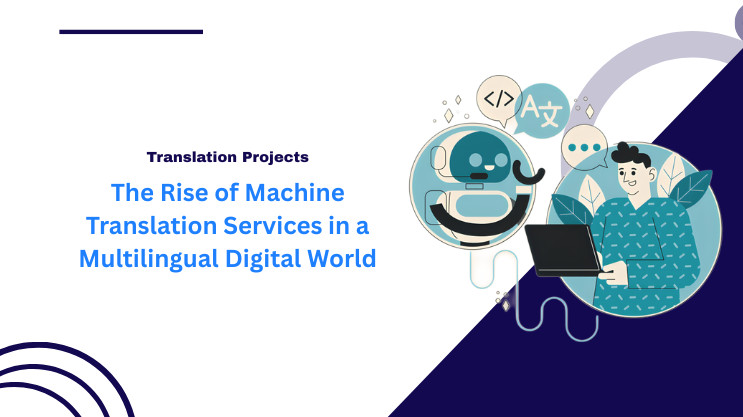
In today’s hyper-connected digital landscape, businesses are no longer confined by geographical boundaries. With audiences spanning continents and languages, the demand for fast, scalable, and cost-effective translation solutions has grown rapidly. This demand has led to the widespread adoption of machine translation (MT) services, transforming how organizations communicate in a multilingual digital world.
Understanding Machine Translation
Machine translation refers to the use of artificial intelligence (AI) and algorithms to automatically translate text or speech from one language to another. Unlike traditional human translation, machine translation delivers results in seconds, making it ideal for high-volume and time-sensitive content.
Modern machine translation systems leverage neural networks and deep learning, allowing them to analyze context, sentence structure, and linguistic patterns more accurately than earlier rule-based systems.
Why Machine Translation Is Growing Rapidly
Several factors have contributed to the rise of machine translation services:
Global Digital Expansion
Websites, mobile apps, e-commerce platforms, and social media channels are increasingly multilingual. Businesses need instant translation to engage users worldwide, and machine translation offers the speed required to keep up with global demand.
Cost and Time Efficiency
Human translation can be expensive and time-consuming for large-scale projects. Machine translation significantly reduces costs and turnaround times, especially for internal documents, product catalogs, and user-generated content.
Advancements in AI and Neural MT
Neural Machine Translation (NMT) has dramatically improved output quality. These systems learn from vast datasets, enabling more natural phrasing, improved grammar, and better handling of complex language structures.
Real-Time Communication Needs
Customer support chats, live chats, emails, and chatbot interactions require immediate responses. Machine translation enables real-time multilingual communication, improving customer experience and satisfaction.
Common Use Cases of Machine Translation Services
Machine translation is widely used across industries for various purposes:
- Website and app content localization
- Multilingual customer support and chatbots
- E-commerce product descriptions
- Internal business communication
- Social media monitoring and engagement
- Technical documentation and knowledge bases
In many cases, machine translation acts as a first step, followed by human review for accuracy and cultural relevance.
Machine Translation vs Human Translation
While machine translation excels in speed and scalability, it is not a complete replacement for human translators.
Machine translation works best for:
- High-volume, low-risk content
- Informational or repetitive text
- Internal and time-sensitive communication
Human translation remains essential for:
- Legal, medical, and financial documents
- Marketing and creative content
- Cultural nuance and brand voice
- Certified and official translations
A hybrid approach, known as Machine Translation Post-Editing (MTPE), combines the strengths of both, delivering faster results without compromising quality.
Challenges of Machine Translation
Despite its advantages, machine translation still faces limitations:
- Difficulty handling idioms, humor, and cultural references
- Inconsistent tone and terminology without customization
- Potential errors in sensitive or technical content
- Lack of emotional and cultural understanding
These challenges highlight the importance of expert oversight, especially for customer-facing or high-impact materials.
The Future of Machine Translation Services
As AI continues to evolve, machine translation will become even more sophisticated. Custom-trained engines, industry-specific glossaries, and improved contextual understanding will further enhance accuracy. Businesses that integrate machine translation strategically-alongside human expertise-will gain a strong competitive advantage in global markets.
Conclusion
The rise of machine translation services reflects the growing need for fast, scalable communication in a multilingual digital world. While it cannot fully replace human translators, machine translation plays a critical role in enabling global reach, improving efficiency, and supporting real-time interactions. By adopting a balanced approach that combines technology with human linguistic expertise, businesses can communicate effectively across languages while maintaining quality, accuracy, and cultural sensitivity.